Meet the district's requirement
We confirm your fire district's water-supply rule and size and document storage to it — the number that actually clears the permit.


Fire Suppression Water Storage
Fire-protection cisterns for mountain and rural Colorado parcels without hydrant coverage — sized to your local fire district's water-supply requirement, connected for draft or a dry hydrant, and often the exact piece that makes a building permit achievable.
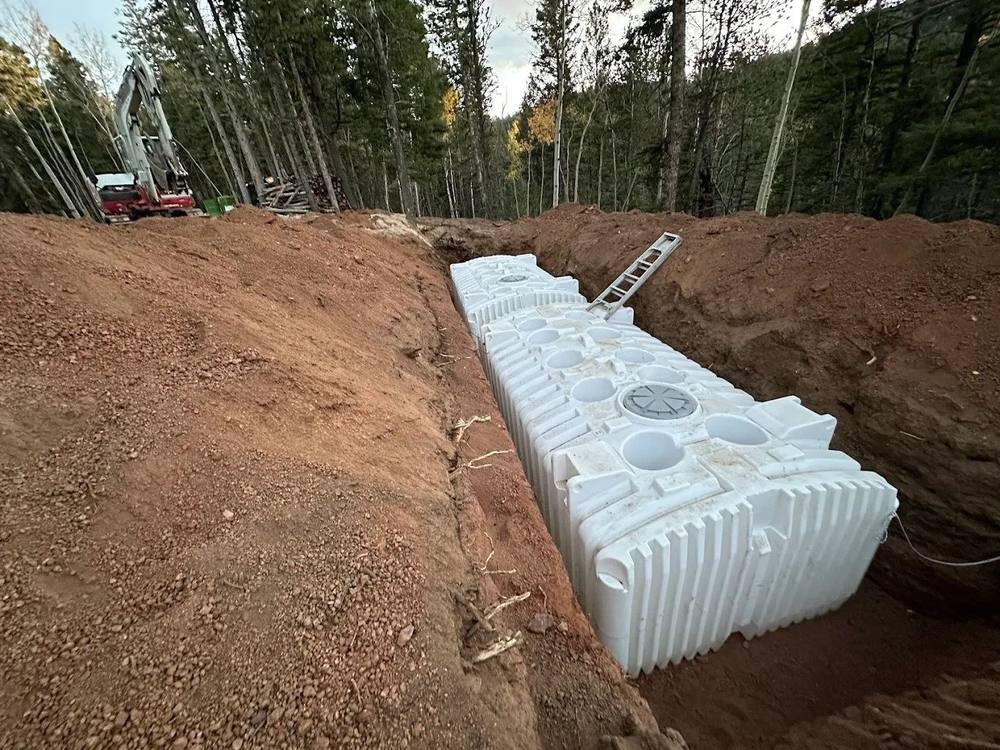
On a parcel with no hydrant, the fire-suppression cistern is frequently the one thing standing between your plans and an approved building permit.
Across Teller, Park, El Paso, and the surrounding high country, most rural and mountain lots sit outside hydrant coverage. Before a county or fire district will approve a build there, they require a dependable on-site fire-suppression water supply — a fixed volume of water the fire department can draw from. We design, install, and document the buried storage that satisfies that condition.
We size the cistern to your specific fire district's water-supply requirement (districts differ, and the number is not negotiable), set it below the frost line, and connect it for fire-department use — a draft port or a dry hydrant the engines can hook to. Then we document it the way the district and county want to see it, so the fire-protection line item on your permit gets signed off instead of stalling your project.
In most cases the smartest build is combined storage: one buried system that carries both your household domestic water and the fire-protection reserve. That way you meet the fire requirement without paying for — and burying — a second tank.
If you're staring at a permit condition for fire-protection water and don't know how to clear it, that's exactly the problem we solve — start to finish, from sizing through the connection the fire marshal signs off on.
We confirm your fire district's water-supply rule and size and document storage to it — the number that actually clears the permit.
A stand-alone fire cistern, or shared storage that also serves the house from one buried system.
Connected for fire-department access — a draft connection or a dry hydrant the engines can pull from.
Set below frost and built to hold its volume year-round in the high country.
Sized and documented the way the fire district and county require, so the condition gets cleared.
Excavation, tank, and connection handled in-house — the same team that does your water and septic.
Already have engineered septic or OWTS plans? Upload the PDF for an instant Colorado installation estimate, then have Tri-Lakes, a licensed Colorado OWTS installer, price and build the system.
If your parcel has no hydrant coverage — which is most rural and mountain lots — your county or fire district almost certainly requires an on-site fire-protection water supply before they'll approve the build. We'll confirm the requirement for your parcel and size it.
It's set by your local fire district's water-supply requirement, not a guess — and districts differ. We pull the actual requirement and size and document the storage to meet it exactly.
Through a draft port or a dry hydrant we install on the cistern — a fixed connection the engines can hook to and draw from. We build it to your district's access standard.
Very often, yes. Combined storage serves both your domestic water and the fire reserve from one buried system, so you build and pay for one tank instead of two.
That's the whole point of it. On a no-hydrant parcel, the fire-protection water condition is frequently the last thing between you and approval — we size, install, and document the system so that line gets signed off.