Potable household cisterns
Buried, freeze-protected storage for full-time domestic use — hauled-water or well-fed, sized for real occupancy, not just a cabin weekend.


Water Storage & Cisterns
Your well fills the tank at its own pace. Your house gets the water it needs, when it needs it. Buried cisterns and submersible booster pumps for mountain and rural Colorado.
Low-yield well. Reliable household water.
Many mountain wells don’t run out of water.
They run out of speed.

Take a well that makes 2 to 5 gallons a minute. That sounds fine until you look at what a house actually asks for. A shower, a washing machine filling, someone flushing while the dishwasher runs—the demand adds up fast. If the house asks for water faster than the well can supply it, the water level drops and the pressure can fall off. Without proper protection, running dry can damage the pump.
Here’s the thing: over a full day, that same well may make plenty. A well that can sustain 2 gallons a minute produces 2,880 gallons in 24 hours—almost 3,000. A household using around 300 gallons a day needs only a fraction of that. The well may have the water. It just can’t deliver it fast enough at the moment you want it.
It fills at a controlled rate matched to what the well can sustain, with recovery time as needed. A float or level control shuts it off when the tank is full. Low-water protection stops the well pump before it runs dry. The well gets to work at its own pace.
Two thousand gallons of storage can carry the morning’s showers and laundry, with capacity sized for your household and guests. Those peak demands draw on the reserve instead of asking the well to keep up in real time. The well quietly catches up between uses.
A deep well pump already has to lift water a long way. When household demand exceeds the well’s recovery rate, that system can struggle to keep up. The cistern separates water production from household pressure.
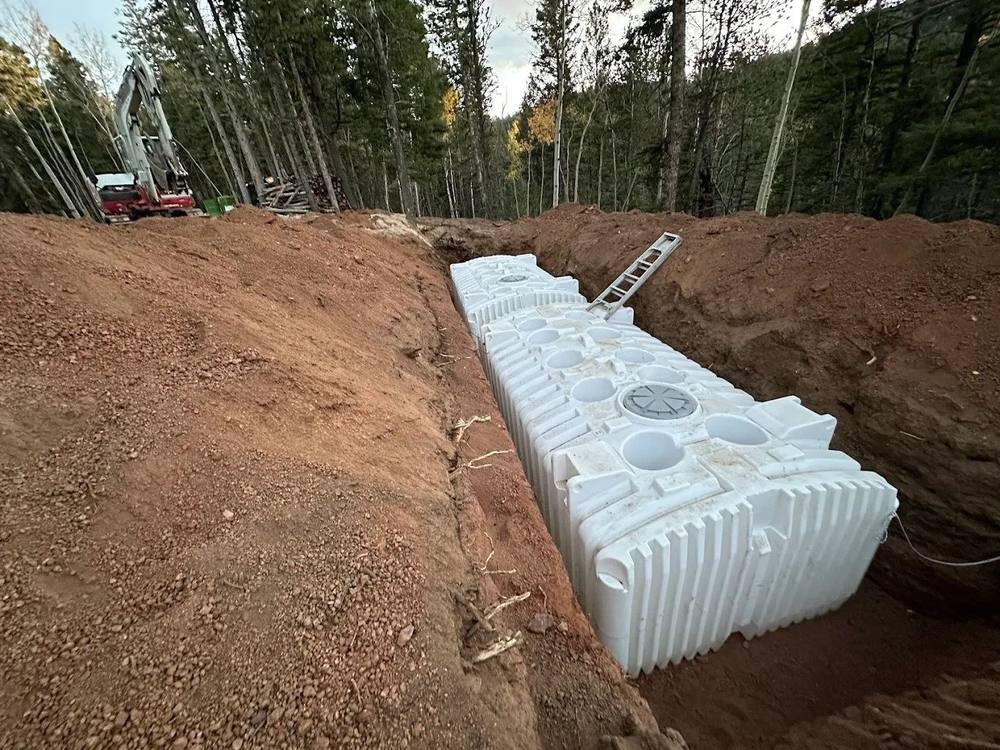
Our typical setup uses a buried Norwesco-style polyethylene cistern with a submersible booster pump inside the tank. The booster draws from stored water and sends it through permanent rigid piping to the house. We size the pump and pressure controls for your fixtures and elevation, so showers and faucets have steady pressure within the system’s designed capacity. That’s the part you’ll feel every single day.
If your well makes enough water over the day but can’t keep up at busy times, a cistern can bridge that gap.
The tank lets the well work slow and the house work fast.
The submersible booster pump supplies the pressure. We size the tank to your household, set the fill controls to your well’s sustainable yield, and protect the well pump from running dry. We also check your existing well permit and local installation requirements. Storage does not expand the uses allowed by your permit.
Talk to us about your wellLearn more: Penn State Extension on low-yield wells · Norwesco cistern tanks · Colorado well permitting.
Buried, freeze-protected storage for full-time domestic use — hauled-water or well-fed, sized for real occupancy, not just a cabin weekend.
Storage for landscape, pasture, livestock, and agricultural use, sized to your draw and refill cycle.
Larger-volume storage and distribution for estates, ranches, and multi-structure properties.
Water where the grid and the well aren't — remote, rocky, steep parcels are our normal.
Cisterns sized to your fire district's water-supply requirement, connected for draft or a dry hydrant.
We haul, excavate, set below frost, backfill, and connect the tank, pump, and distribution — start to finish.
Already have engineered septic or OWTS plans? Upload the PDF for an instant Colorado installation estimate, then have Tri-Lakes, a licensed Colorado OWTS installer, price and build the system.
It depends on tank size, excavation, access, source, and pump requirements. We quote the complete installation for your actual site and water use.
A cistern can supplement a low-yield well or store delivered potable water. Whether hauled water can serve as the primary supply depends on your property and local approval requirements.
Requirements vary by jurisdiction and property. We check the proposed water source, storage capacity, and installation with the local authority before treating a cistern as an approved supply for occupancy.
It comes down to household size, whether the cistern is your only source, your refill method (hauled vs. well-fed), and whether it doubles as fire storage. We size it with you so you're not paying for volume you'll never use — or running dry.
A permitted well or approved delivered-water supply fills the tank. Our typical well-fed installation uses controlled filling, a buried poly cistern, and a submersible booster pump inside the tank to feed the house through permanent rigid piping.
A combined system may be possible with the fire district’s approval. Required fire reserve, access, and connections must be designed into the system so household use does not consume the required reserve.